




Scientists have announced the discovery of a new extinct crocodile species, Herugavialis cairensis, after re-examining a 45-million-year-old fossil found in Egypt. The identification of this species has drawn international attention due to its potential links to the ancient geology of Egypt and the mysteries surrounding its historic monuments.
The fossil, originally unearthed in 1927 in the Mokattam Hills near Cairo, was recently re-analysed using modern CT scanning technology, according to multiple scientific sources. For nearly a century, the specimen had been classified as belonging to the Tomistoma genus, but new research led by paleontologist Paul Burke and his team has revealed it represents a distinct species.
Herugavialis cairensis is believed to have lived around 45 million years ago, during a period when the region that is now northeastern Egypt was covered by shallow seas. The fossil was found in the Mokattam Formation, a geological layer that has yielded numerous marine and terrestrial fossils from the Eocene epoch.
Some reports, including social media posts from scientific organisations, suggest that the fossil was embedded in the same type of rock used to construct the Great Sphinx of Giza. However, this detail has not been universally confirmed by all sources. The connection, if verified, could provide new insights into the ancient environment of the area and the materials used by early Egyptian builders.
Researchers say the newly identified species resembles the modern gharial, a long-snouted crocodilian native to India, but with distinct features that set it apart from both living and extinct relatives. The discovery was made possible by advanced imaging techniques that allowed scientists to examine internal bone structures without damaging the fossil.
The Mokattam Hills, where the fossil was discovered, are a well-known paleontological site in Egypt. The area has produced a range of marine fossils, reflecting its ancient origins as a seabed. The identification of Herugavialis cairensis adds a significant new chapter to the region’s fossil record.
The study has attracted attention from both the scientific community and the public, with many noting the potential implications for understanding the evolution of crocodilians and the ancient ecosystems of North Africa. There has also been renewed interest in the relationship between Egypt’s geological history and its iconic monuments.
While the precise location of the fossil within the Mokattam Formation has not been detailed in all sources, the use of modern technology to revisit historic finds is being hailed as a model for future paleontological research. Scientists say further analysis could reveal more about the species’ lifestyle and its role in the prehistoric environment.
Why it matters
The identification of Herugavialis cairensis highlights the value of re-examining historic fossil collections with new technology. The research team, led by Paul Burke, used CT scanning to uncover anatomical details that had been overlooked for decades, demonstrating how advances in imaging can transform scientific understanding.
This discovery also underscores the geological significance of Egypt’s Mokattam Hills, which not only provided building materials for ancient monuments but also preserve evidence of the region’s prehistoric life. The possible link between the fossil’s rock matrix and the Sphinx’s construction stone, though not yet confirmed by all sources, has sparked fresh debate about the intersection of natural history and human civilization in Egypt.
By expanding knowledge of crocodilian evolution in Africa, the find may influence future research on both extinct and living species. The case of Herugavialis cairensis shows how international collaboration and new technologies are reshaping paleontology in Egypt and beyond.
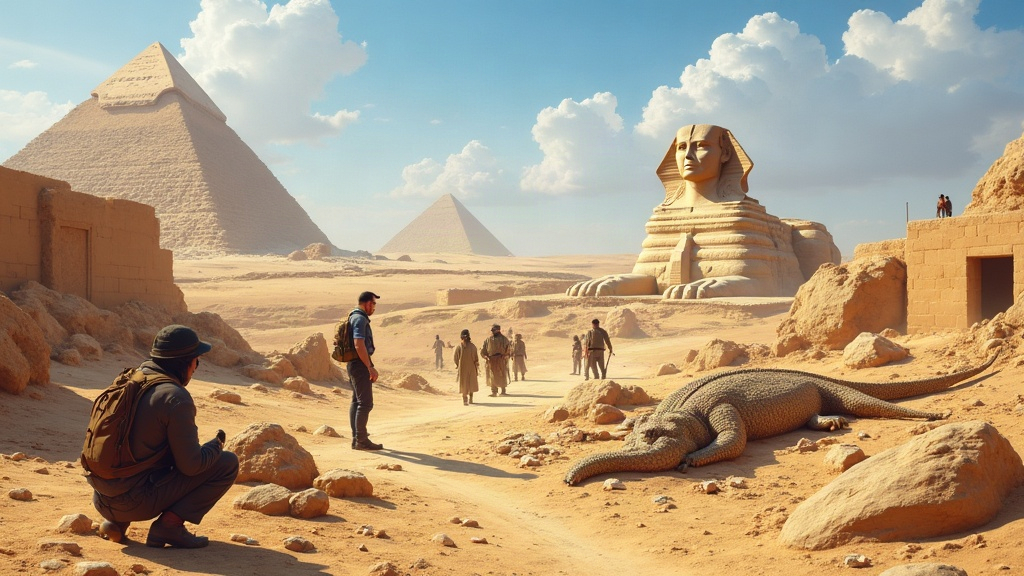
The image accompanying this article is an AI-generated illustrative depiction inspired by the actual scene of the event.