




Scientists have announced the identification of one of the oldest Martian meteorites ever found on Earth, a discovery that is shedding new light on the Red Planet’s ancient past. The meteorite, named Teghaza 001, was discovered in the Sahara Desert and has been dated to more than 4.1 billion years ago, according to a study published in the journal Science.
The NASA-funded research team determined that Teghaza 001 is not only among the oldest of the 435 Martian meteorites identified on Earth, but also provides an unprecedented glimpse into the early history of Mars. The rock is believed to have formed during a period when Mars was geologically active and had liquid water on its surface, a finding that could help scientists better understand the planet’s evolution.
Teghaza 001 was found on a salt plain in Mali in 2022. Its unassuming appearance—dark and polished with a reddish stripe—belies its scientific significance. Researchers say the meteorite’s minerals and texture distinguish it from other Martian meteorites, making it a unique specimen for planetary scientists.
According to NASA, the meteorite’s igneous, or volcanic, minerals set it apart from others in its class. Only two other meteorites, Allan Hills 84001 and Northwest Africa 7034, have previously provided snapshots of a young Mars, but Teghaza 001 offers a broader view of the Martian crust and mantle during the planet’s formative years.
Lead author Liu described Teghaza 001 as a “Rosetta Stone for Mars,” noting that its age and composition offer rare clues about the planet’s early geologic and hydrologic processes. The meteorite’s chemical makeup closely matches that of Mars’ Noachian southern highlands, an ancient region identified by NASA’s Mars Reconnaissance Orbiter. Researchers have pinpointed 13 possible locations on Mars that could be the meteorite’s origin.
Analysis of Teghaza 001 revealed evidence of interactions between water and rock, suggesting that Mars once had a more complex water cycle than it does today. A separate study published earlier this year detailed the meteorite’s water content, providing further insight into how water shaped the Martian surface billions of years ago.
University of Maine professor Alicia Cruz-Uribe, a co-author of the study, highlighted the significance of the discovery for understanding Mars’ geologic history. Using advanced laser ablation techniques, her team was able to date the meteorite without destroying valuable samples, confirming its ancient origins and importance for planetary science.
Martian meteorites are believed to have been ejected from Mars when impactors struck the planet, sending debris into space that eventually landed on Earth. Teghaza 001’s journey from Mars to the Sahara Desert provides a rare opportunity to study material from the Red Planet’s distant past.
The discovery has generated excitement among planetary scientists, who see Teghaza 001 as a key to unlocking new information about Mars’ early environment. The findings could help answer longstanding questions about the possibility of ancient life on Mars and the planet’s capacity to support water over geological timescales.
Why it matters
The identification of Teghaza 001 as one of the oldest Martian meteorites ever found marks a significant advance in the study of Mars’ early history. According to NASA and the research team, the meteorite’s age and composition provide a rare window into a time when Mars was more geologically active and had liquid water on its surface—conditions that are crucial for understanding the planet’s potential to have supported life.
Unlike most Martian meteorites, which offer limited views of the planet’s past, Teghaza 001 contains a diverse mix of igneous minerals and evidence of water-rock interactions. These features, highlighted in the Science study and by researchers such as Liu and Cruz-Uribe, make it a valuable reference point for future Mars exploration and for interpreting data from current missions like NASA’s Mars Reconnaissance Orbiter.
As scientists continue to analyze Teghaza 001, the meteorite is expected to inform ongoing debates about Mars’ early climate, the formation of its crust, and the history of water on the planet. The findings may also guide future sample-return missions and help refine the search for ancient biosignatures on Mars, making this discovery a pivotal moment in planetary science.
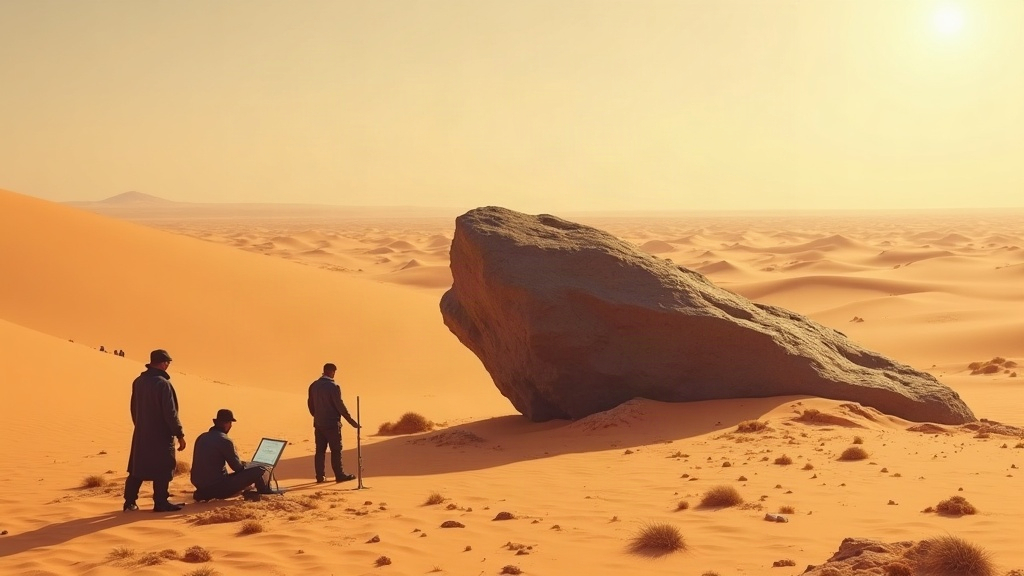
The image accompanying this article is an AI-generated illustrative depiction inspired by the actual scene of the event.