




Poundland, the UK’s largest single-price retailer, has entered administration after its US owner Gordon Brothers withdrew funding, putting more than 10,000 jobs at risk just weeks before Christmas.
The collapse, confirmed on 25 November, affects around 600 stores across the UK and Ireland, as well as the company’s Walsall-based headquarters. AlixPartners has been appointed as administrator, with the business expected to be broken up and sold off to competitors.
According to staff, the news has come as a “crushing blow”. Jack Dukes, who works in IT at Poundland’s head office, told media that employees at the Walsall site have been asked to attend a meeting at 09:30 GMT on Thursday to learn more about their futures. Dukes expressed fears that all roles could be under threat, and described the workplace as a “tight-knit family”.
“It really is a crushing blow,” Dukes said, adding that he has reached out to colleagues to offer support, particularly regarding mental health concerns. He noted that he has already begun searching for new employment, citing his experience as a positive factor in his job hunt.
The administration not only threatens the livelihoods of Poundland’s 11,000 staff, but also has significant implications for thousands of suppliers. Dukes highlighted that many suppliers have not been paid for new stock since October, and some depend entirely on Poundland for their trade.
Retail analysts expect that while some stores may be acquired by competitors such as B&M and Poundstretcher, hundreds of locations are likely to be left empty. Some workers could be retained under new ownership, but many face redundancy and a period of deep uncertainty regarding pay and entitlements.
The collapse is also expected to impact local economies, particularly in areas where Poundland is a key anchor for high street shopping. Dukes warned that the closure could lead to reduced footfall for surrounding shops, cafes, and businesses, many of which already operate on tight margins.
Poundland’s administration follows a period of financial difficulty, with its owner failing to secure a takeover deal. The company’s struggles have been compounded by broader challenges facing UK high streets, including rising costs, changing consumer habits, and increased competition from online retailers.
Staff at the Walsall headquarters and across the store network are now awaiting further information from the administrators about the future of their roles and the potential for store sales or closures. The uncertainty is expected to continue for several weeks as the administration process unfolds.
Why it matters
The collapse of Poundland is a significant blow to the UK’s retail sector, directly affecting more than 10,000 employees and thousands of suppliers, according to statements from staff and administrators. As the country’s largest single-price retailer, Poundland’s presence on high streets has been a key driver of footfall for surrounding businesses, particularly in economically vulnerable areas.
Jack Dukes, speaking from the Walsall head office, highlighted the wider impact on local economies, noting that many shops and cafes rely on the customer traffic generated by Poundland. The risk of hundreds of empty retail units could accelerate the decline of high streets already struggling with reduced margins and changing shopping habits.
The administration also underscores the fragility of the discount retail sector, which has faced mounting pressures from inflation, supply chain disruptions, and shifts to online shopping. The outcome of the administration process, including potential store acquisitions by B&M and Poundstretcher, will shape the future landscape of the UK’s retail industry and the livelihoods of thousands of workers and suppliers.
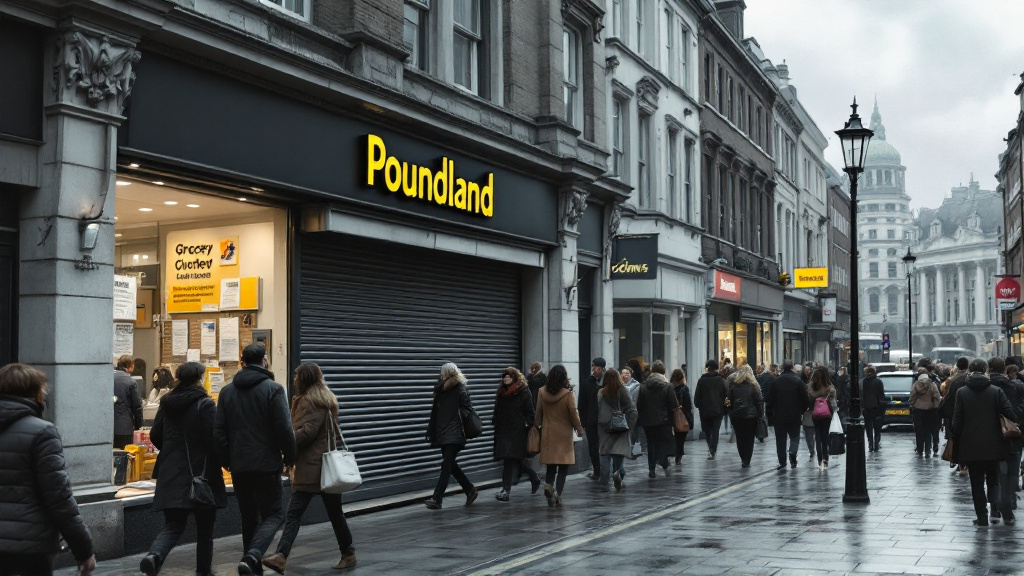
The image accompanying this article is an AI-generated illustrative depiction inspired by the actual scene of the event.