




SpaceX launched its Starship rocket on Flight 15 from Starbase, Texas, today, aiming to achieve the first-ever recovery of both the Super Heavy booster and the Starship upper stage. The test represents a major step toward fully reusable orbital rockets, a goal central to SpaceX’s ambitions for future space missions.
The launch took place at 5:47 p.m. Eastern Time, with the Super Heavy booster and Starship Ship upper stage lifting off under the power of 33 Raptor engines. According to Space.com and CNN, the booster separated as planned and attempted a landing in the Gulf of Mexico. However, the landing was not successful, ending in an explosion shortly after touchdown.
Despite the setback with the booster, the upper stage—known as Ship—successfully entered orbit and began its nearly 22-hour flight around Earth. SpaceX has confirmed that Ship is on course to return to Starbase, with the attempt to land and recover the upper stage scheduled for Saturday afternoon. If successful, this would mark the first time an orbital-class spacecraft has returned to its launch site for recovery after completing a full orbit.
The mission also carried a heat shield tile signed by YouTuber Mr. Beast and deployed 26 Starlink V3 satellites, according to the official SpaceX summary. The flight was streamed live on multiple platforms, including Elon Musk’s X, drawing significant public attention to the high-stakes test.
SpaceX’s attempt to recover both rocket stages in a single mission is unprecedented. While the company has previously landed and reused Falcon 9 first stages, the Starship system is designed to be fully reusable, with both the Super Heavy booster and the Starship upper stage intended to be caught by giant mechanical arms at the launch tower, sometimes referred to as “chopsticks.”
According to CNN and Space.com, the upper stage’s return is particularly challenging. The spacecraft must survive reentry at speeds exceeding 20 times the speed of sound, then maneuver for a controlled descent and landing at Starbase. SpaceX has prepared contingency plans, including the option to divert to a splashdown in the Gulf of Mexico or other pre-cleared ocean sites if problems occur during the return phase.
The mission comes after a series of test flights in which SpaceX has gradually increased the complexity of Starship launches. Previous flights have seen partial successes, with boosters landing offshore and upper stages demonstrating controlled descents, but none have attempted a full return and catch at the launch site after an orbital flight.
Reactions from the space community have been closely tied to the outcome of the booster landing and the pending return of the upper stage. While the failed booster recovery is a setback, industry observers note that the primary focus remains on the upper stage’s return, which could set a new benchmark for reusable spaceflight if successful.
Why it matters
The outcome of Flight 15 is critical for SpaceX’s long-term plans, including the development of a fully reusable launch system capable of supporting missions to the Moon, Mars, and beyond. According to Space.com, a successful return and recovery of the Starship upper stage would represent a “major milestone” for both the company and the wider space industry, demonstrating the feasibility of rapid reusability for large orbital rockets.
This mission also has implications for the commercial satellite market and future crewed missions. The deployment of 26 Starlink V3 satellites during the flight highlights Starship’s role in expanding SpaceX’s satellite internet network, while the test of recovery systems is essential for eventual human spaceflight operations. As CNN notes, proving the ability to recover and quickly reuse both stages is a necessary step toward the high launch cadence required for ambitious goals like Mars colonization.
With the Starship upper stage still in orbit and its return attempt imminent, attention remains focused on Starbase, Texas. The results of this mission will inform not only SpaceX’s next steps but also the strategies of other space industry players pursuing reusable launch technologies.
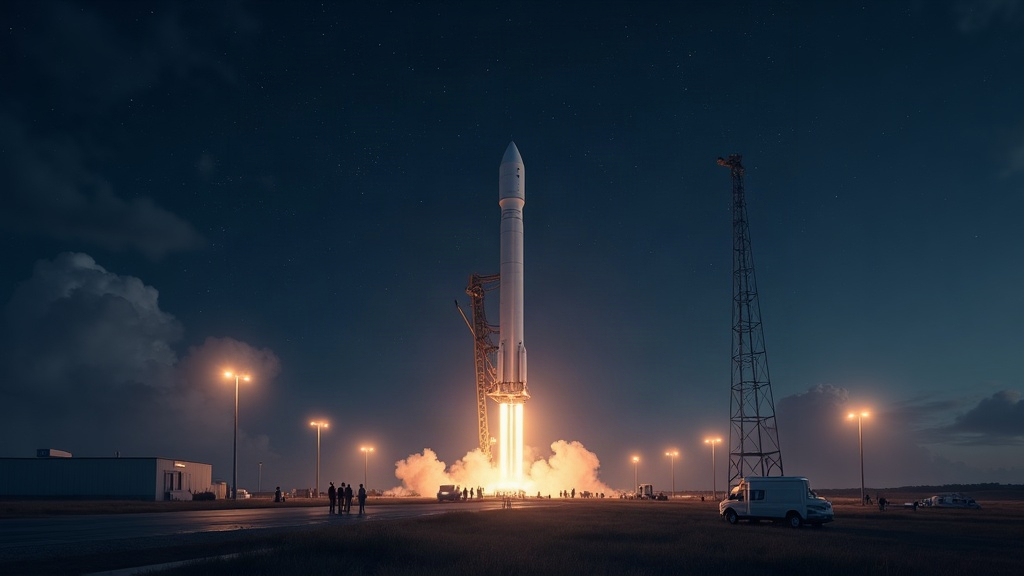
The image accompanying this article is an AI-generated illustrative depiction inspired by the actual scene of the event.