




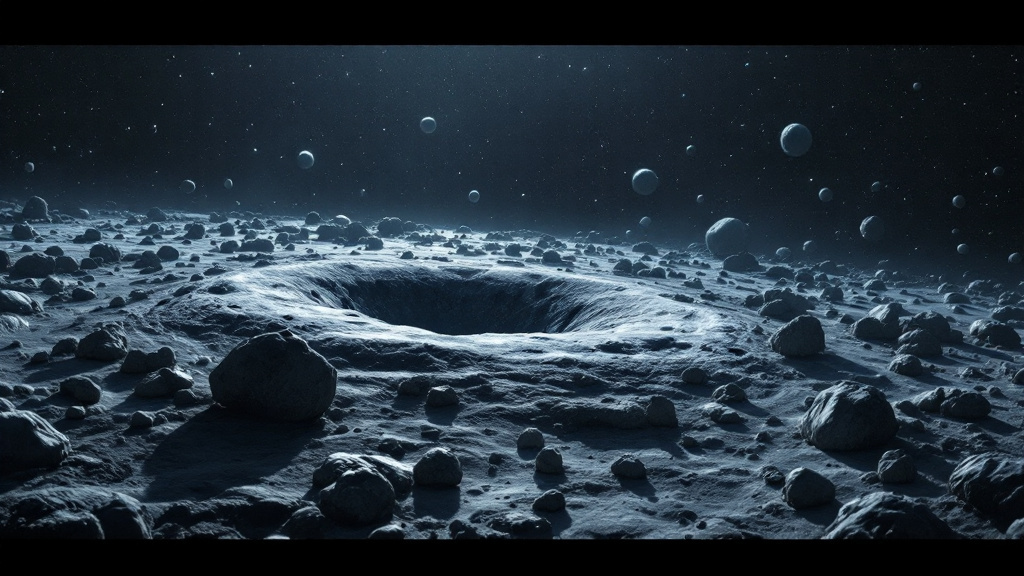
Newly released images from the European Space Agency’s Hera spacecraft have revealed a vast, stadium-sized crater on the asteroid Dimorphos, the result of NASA’s deliberate collision in a test of planetary defence. The close-up photographs, published today, show the aftermath of the Double Asteroid Redirection Test (DART), which struck the asteroid in 2022 to assess whether a space rock could be knocked off course if it ever threatened Earth.
The Hera mission, which arrived at the Didymos-Dimorphos binary asteroid system earlier this month, is now providing scientists with their first detailed look at the impact site. According to ESA officials, the images show that the crater left by DART’s impact is almost as large as Dimorphos itself, dramatically reshaping the small asteroid’s surface.
Dimorphos, a moonlet orbiting the larger asteroid Didymos, is now observed to be tumbling chaotically in its orbit. Scientists say the asteroid’s motion has become much more erratic since the impact, a finding that has surprised mission teams and will be crucial for understanding the dynamics of asteroid deflection strategies.
Alongside the enormous crater, Hera has detected hundreds of boulders now orbiting the Didymos-Dimorphos system. These fragments, ranging from tens of centimeters to several meters in size, are believed to have been ejected by the force of the collision. The presence of this debris cloud is offering researchers new insights into how such impacts can disperse material in space.
The DART spacecraft, weighing about as much as a large horse, struck Dimorphos at a speed of 23,000 kilometers per hour. The impact succeeded in shortening Dimorphos’s 12-hour orbit around Didymos by 33 minutes, a result that exceeded NASA’s initial expectations, according to data collected from Earth-based telescopes.
Scientists have described Hera’s mission as a critical follow-up, likening it to “Inspector Columbo going back to the crash scene to investigate what is the outcome of this impact,” as ESA’s principal investigator Patrick Michel told the BBC. The spacecraft will spend the next year conducting a detailed survey of both Dimorphos and Didymos, measuring the size and depth of the crater and analyzing how the collision altered the asteroids’ orbits and structures.
The DART test marked the first time humanity has attempted to change the path of a celestial object, a milestone in planetary defence efforts. NASA and ESA emphasize that Dimorphos and Didymos pose no threat to Earth; the mission was designed purely as a test to prepare for any future asteroid threats.
Researchers are now focused on understanding the full consequences of the impact, including the unexpected chaotic tumbling of Dimorphos and the dispersal of debris. These findings will inform future strategies for deflecting potentially hazardous asteroids, as well as models predicting how such bodies respond to high-speed impacts.
Why it matters
The Hera mission’s findings represent a major advance in planetary defence research, providing the first direct evidence of how a kinetic impact can reshape and redirect an asteroid. The scale of the crater and the chaotic motion observed by ESA scientists highlight the unpredictable consequences of such interventions, underlining the importance of close-up follow-up missions like Hera.
This new data is crucial for agencies such as NASA and ESA as they refine their models for asteroid deflection. The unexpected magnitude of Dimorphos’s orbital change and the discovery of hundreds of orbiting boulders suggest that future planetary defence missions will need to account for complex secondary effects, not just the primary impact. According to ESA, these insights will help ensure that Earth is better prepared for any real asteroid threat in the future.
The collaboration between NASA and ESA on DART and Hera demonstrates the growing international commitment to planetary defence. As Hera continues its survey, scientists worldwide will be watching closely for further findings that could shape the next generation of asteroid mitigation strategies.
The image accompanying this article is an AI-generated illustrative depiction inspired by the actual scene of the event.