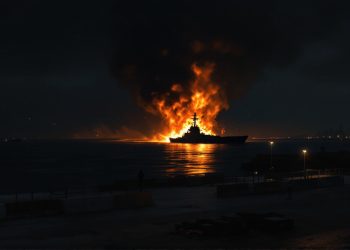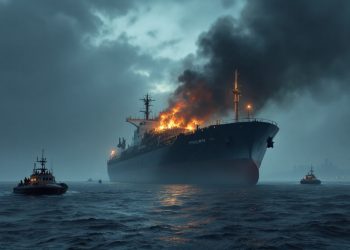





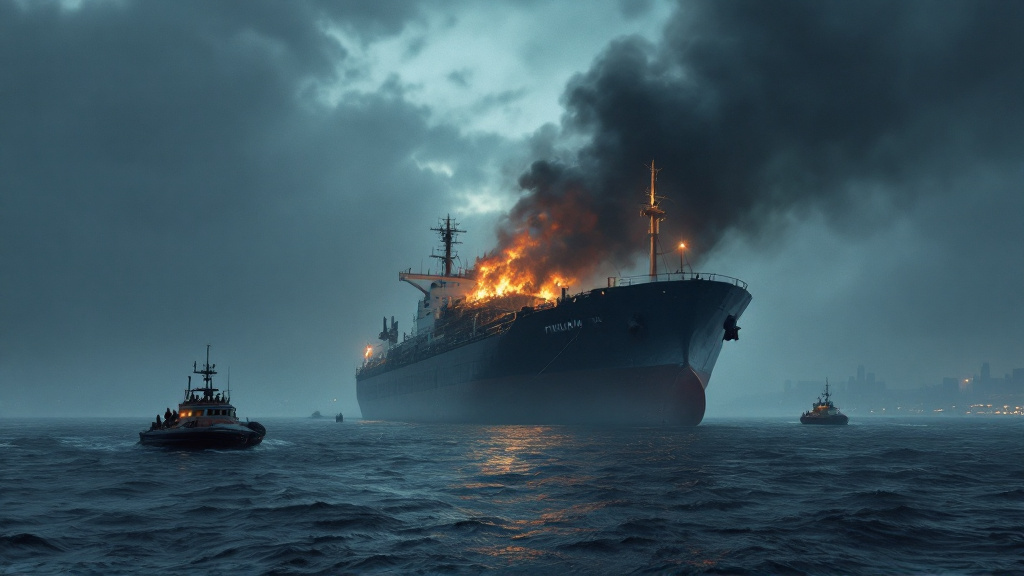
A Russian cargo ship linked to the country’s military remains on fire in Finnish waters today after being struck by drones in the Baltic Sea, according to Finnish and Russian authorities. The vessel, identified as the Sparta II, was targeted on Saturday, forcing its 16-member crew to evacuate and raising concerns about the security of maritime routes in the region.
Finnish rescue teams worked through the night to contain the blaze, deploying water cannons to douse flames and cool the containers on deck, according to the Finnish Coast Guard. The vessel, still anchored in Finnish waters, continues to burn as of Sunday, with firefighting efforts ongoing.
The Sparta II was en route from St. Petersburg to the Russian exclave of Kaliningrad when it was hit in international waters west of Russia’s Gogland island, Finnish Defence Forces said. The crew abandoned ship in lifeboats and were picked up by a nearby Russian vessel, which transported them back to Russia, Finnish Border Guard Commander Ilja Iljin told public broadcaster Yle.
Finland’s military has stated that the attack was likely carried out by Ukraine, though Ukrainian officials have not publicly claimed responsibility. The incident comes amid a series of drone strikes in the Baltic region, with Finnish authorities noting a previous strike on a Russian warship in the same area last week.
The Sparta II is a 121-meter Russian-flagged cargo vessel owned by Oboronlogistika, a shipping company that provides logistics services for the Russian Ministry of Defence. The ship is subject to U.S. sanctions, according to the U.S. Department of the Treasury, and has also been sanctioned by Ukraine earlier this year.
According to Kaliningrad Governor Alexei Besprozvannykh, preliminary information suggests that two drones were used in the attack. He stated there is “no threat” to supplies reaching Kaliningrad at this time. Video released by the Finnish coast guard shows thick smoke billowing from the ship as multiple vessels attempt to control the fire.
Finland imposed temporary aviation and maritime restrictions in the area following the incident. Prime Minister Petteri Orpo commented on social media that “war is spilling over into our immediate vicinity,” emphasizing Ukraine’s right to defend itself against Russian aggression.
Estonian Navy Commander Ivo Vark told public broadcaster ERR that the risk of further attacks in the Gulf of Finland cannot be ruled out, highlighting the growing security concerns in the Baltic Sea region. The Gulf of Finland is a strategically significant waterway, serving as a critical route for both commercial and military shipping between Russia, Finland, and Estonia.
Why it matters
The attack on the Sparta II marks a significant escalation in the spillover effects of the ongoing war between Russia and Ukraine, bringing direct military-linked incidents into the Baltic Sea and Finnish territorial waters. As noted by Finnish Prime Minister Petteri Orpo, this event underscores how the conflict is now impacting regions previously considered peripheral to the main theatre of war.
The involvement of a vessel owned by Oboronlogistika—a company providing logistics for the Russian Defence Ministry and subject to U.S. and Ukrainian sanctions—demonstrates the expanding scope of targets in the conflict. The incident also raises concerns about the security of maritime traffic in the Gulf of Finland, a vital corridor for both civilian and military logistics. Estonian Navy Commander Ivo Vark’s warning about the risk of further attacks highlights the potential for increased instability in the region.
With Finnish authorities still battling the fire and no claim of responsibility from Ukraine, the situation remains fluid. The episode is likely to prompt further scrutiny of maritime security in Northern Europe and could lead to heightened tensions between Russia, its neighbors, and NATO members bordering the Baltic Sea.
The image accompanying this article is an AI-generated illustrative depiction inspired by the actual scene of the event.