




China’s ruling Communist Party has placed President Xi Jinping’s long-running anti-corruption campaign at the centre of a major meeting of its top leadership, as officials gather in Beijing this week for the fifth plenum of the Central Committee. The closed-door session, which began on Monday, is expected to reinforce party discipline and loyalty to Xi, according to reports from Reuters and other international outlets.
The plenum brings together roughly 300 full and alternate members of the Central Committee, the party’s largest decision-making body, for four days of deliberations. The official agenda, according to Reuters, is focused on tightening discipline within party ranks, with key discussions likely to include personnel moves and the handling of disgraced former officials.
Xi Jinping’s anti-corruption campaign, now in its fourteenth year, has already resulted in the investigation and removal of thousands of officials at various levels of government. According to Cedar News, the pace of investigations remains high, with disciplinary authorities opening new probes last year and the issue of corruption continuing to feature prominently in party discussions.
Some analysts, as cited by The Guardian and Blue Virginia, have questioned whether the campaign is primarily about rooting out corruption or ensuring loyalty to Xi. The latest meeting comes amid ongoing speculation about the future direction and duration of the crackdown, with no official timeline provided for when or if the campaign might wind down.
While the plenum is officially framed as a routine gathering ahead of the party’s next congress in 2027, observers note that the focus on discipline and unity is widely seen as an effort by Xi to cement his authority and potentially pave the way for a fourth term as leader. The official proceedings are held under tight security, with no public mention of internal disagreements, according to Reuters.
Sources report that a more detailed document outlining the outcomes of the plenum is expected to be released several days after the meeting concludes. In the past, such meetings have been held at the Soviet-era Jingxi Hotel in western Beijing, though the location for this year’s session has not been officially disclosed.
The anti-corruption campaign has become a defining feature of Xi’s leadership, reshaping the political landscape and sending a clear message about the centralisation of power within the party. The campaign’s reach has extended into the highest echelons of government, with several senior figures investigated or removed in recent years.
According to party officials and state media, the ongoing crackdown is intended to strengthen the party’s legitimacy and maintain public trust. However, critics and independent analysts continue to debate the extent to which the campaign targets genuine corruption versus consolidating political control.
Why it matters
The prominence of Xi Jinping’s anti-corruption drive at the fifth plenum signals the continued centrality of party discipline and personal loyalty to the president in China’s political system. With the Central Committee meeting described by Reuters as a key moment ahead of the 2027 party congress, the outcomes could influence the balance of power and future leadership succession within the world’s most populous country.
The campaign’s persistence, as reported by Cedar News and The Guardian, underscores Xi’s determination to control both the narrative and the mechanisms of accountability inside the party. The ongoing investigations and purges have already reshaped China’s political elite, with implications for governance, policy continuity, and the stability of the Communist Party’s rule.
As the plenum continues behind closed doors, observers are watching for signs of further personnel changes and policy directions that may emerge in the coming days. The official focus on unity and discipline, coupled with the lack of transparency about internal debates, highlights the opaque nature of decision-making at the top of China’s political hierarchy.
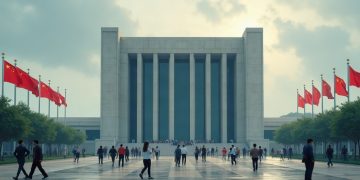
The image accompanying this article is an AI-generated illustrative depiction inspired by the actual scene of the event.