




A powerful earthquake with a magnitude of 7.0 struck a remote, mountainous region of Tibet, China, late Thursday evening, resulting in casualties and raising concerns about the impact on local communities. The quake, which occurred at approximately 10:33 p.m. local time, was centered in a high-altitude area about 190 kilometers east-northeast of Nagqu, according to the United States Geological Survey (USGS) and Chinese monitoring agencies.
Authorities have confirmed that at least 16 people were killed and 32 others injured in the aftermath of the earthquake, according to local officials cited by usa.inquirer.net. However, some sources, including initial reports from Reuters and AccuWeather, noted that the full extent of damage and casualties remains unclear as rescue and assessment operations continue in the affected region.
The epicenter was located in a sparsely populated county within Nagqu, northern Tibet, with the China Earthquake Networks Center (CENC) reporting the quake at a depth of 10 kilometers. The region is known for its high elevation, with the average altitude near the epicenter exceeding 4,800 meters, making rescue efforts particularly challenging.
Shaking from the earthquake was strongly felt across the local area, prompting concerns for residents in nearby towns and villages. The quake is the strongest to hit China since January 2024, according to CENC, and comes in a region where seismic activity has historically led to significant destruction and loss of life.
Emergency response teams have been dispatched to the region to assess the situation and provide assistance to those affected. The remote location and rugged terrain are expected to complicate rescue operations, and authorities have warned that casualty figures may rise as more information becomes available.
Seismologists are continuing to monitor the area for aftershocks, with the USGS and CENC both indicating that the reported magnitude and depth may be subject to revision as more data is analyzed. Aftershocks are a common occurrence following large earthquakes and can pose additional risks to survivors and first responders.
Tibet, situated on the seismically active Himalayan plateau, has experienced several major earthquakes in recent decades. The region’s vulnerability is heightened by its challenging geography and limited infrastructure, which can impede rapid disaster response.
Authorities have urged residents to remain alert for further tremors and to follow official guidance as search and rescue operations continue. The situation is still developing, and officials are expected to provide updates as more information about the impact and response efforts emerges.
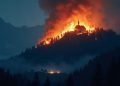
The image accompanying this article is an AI-generated illustrative depiction inspired by the actual scene of the event.