




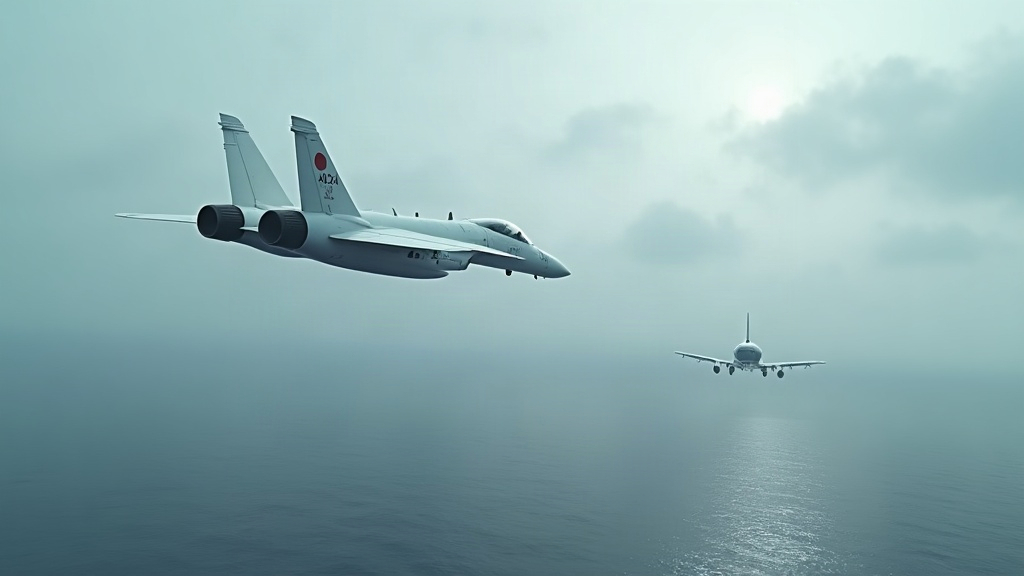
Japan scrambled fighter jets early Tuesday after two suspected Russian military aircraft entered its airspace near Okinoshima, a small island off Fukuoka Prefecture in southwestern Japan. The incursion, which occurred shortly after 4 a.m. local time, prompted Tokyo to issue a strong diplomatic protest to Moscow, calling the violation a grave infringement of its sovereignty and a threat to national security.
According to Chief Cabinet Secretary Minoru Kihara, the two aircraft each remained inside Japanese airspace for approximately three minutes before leaving. The Japan Air Self-Defence Force dispatched fighter jets to intercept the planes and issued warnings, officials said. The incident marks one of the most serious airspace violations involving Russian aircraft in recent years, as reported by multiple Japanese government sources.
“The violation of our national airspace by Russian aircraft is not only a grave infringement of our country’s sovereignty, but also a threat to our security and is completely unacceptable,” Kihara told reporters in Tokyo. He confirmed that Japan had lodged a “very stern protest” with Russia through diplomatic channels and strongly demanded measures to prevent any recurrence of such incidents.
Japan’s Ministry of Defence stated that the suspected Russian aircraft entered Japanese airspace northwest of Okinoshima, having travelled through the Tsushima Strait. After the incursion, the planes reportedly continued their flight path between Yonaguni Island and Taiwan before heading towards the Pacific Ocean.
This latest incident comes amid heightened military activity across East Asia. South Korea also reported on Tuesday that it had deployed fighter jets and conducted tactical manoeuvres after several Russian military aircraft entered its air defence identification zone (KADIZ) over the East Sea, also known as the Sea of Japan. Seoul’s Joint Chiefs of Staff said the Russian aircraft did not violate South Korean airspace but prompted a swift response from its air force.
Japan has experienced several airspace violations by Russian military aircraft in the past, but such incidents remain relatively rare. According to the Japanese Defence Ministry, a similar protest was lodged with Russia in 2024 after a Russian patrol plane entered Japanese airspace three times, marking the first confirmed incursion since 2019.
Relations between Japan and Russia have been strained in recent years, particularly over territorial disputes and increased military activity in the region. The latest airspace violation is expected to further complicate diplomatic ties between the two countries, which have already been under pressure due to broader geopolitical tensions.
Tokyo’s response underscores its concerns about the security environment in East Asia, where both Russian and Chinese military operations have increased in frequency. Japan has repeatedly called for respect of its territorial integrity and has sought assurances from neighbouring countries to avoid provocative actions near its borders.
Why it matters
The airspace violation near Okinoshima highlights the ongoing volatility in East Asia’s security environment, where military manoeuvres by Russia and other regional powers have become more frequent. According to Chief Cabinet Secretary Minoru Kihara, such incidents are seen as direct threats to Japan’s sovereignty and national security, prompting immediate diplomatic and military responses.
This event also comes at a time when South Korea reported a similar encounter with Russian military aircraft in its air defence identification zone, indicating a broader pattern of increased Russian aerial activity in the region. The Japanese Defence Ministry’s decision to scramble jets and issue warnings demonstrates the heightened alertness of regional militaries and the potential for rapid escalation if airspace boundaries are not respected.
With Japan and Russia already at odds over unresolved territorial disputes and ongoing geopolitical tensions, the latest incursion underscores the fragility of diplomatic relations. The swift protest lodged by Tokyo and the demand for preventive measures reflect Japan’s determination to safeguard its airspace, while also signalling to other regional actors that such violations will not be tolerated. Observers will be watching closely for Moscow’s response and any further military movements in the area.
The image accompanying this article is an AI-generated illustrative depiction inspired by the actual scene of the event.