





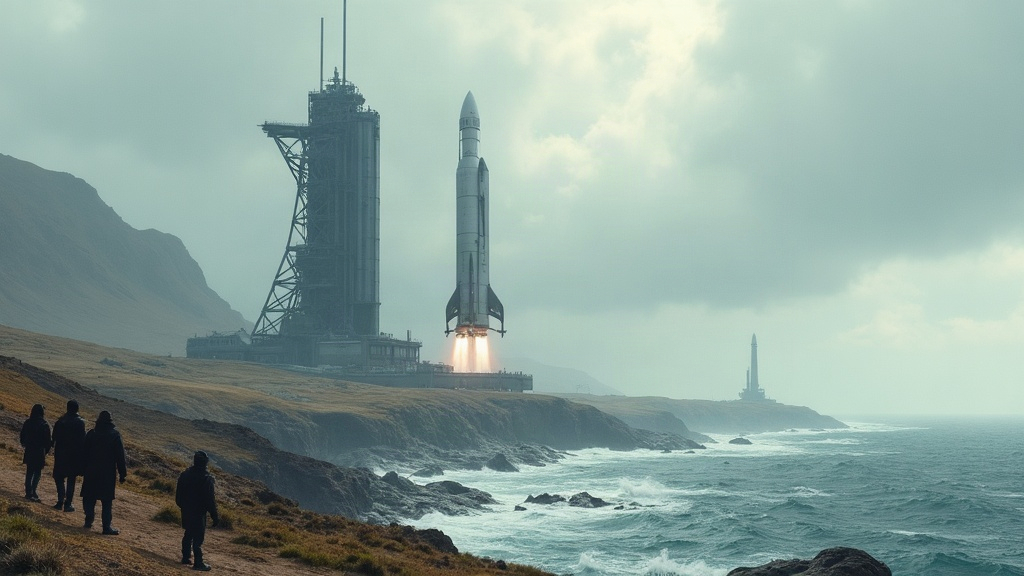
SpaceX has successfully caught the upper section of its Starship rocket as it returned to Earth, marking a major milestone in the company’s efforts to develop fully reusable launch vehicles. The dramatic midair catch took place at SpaceX’s Texas launch site, where giant mechanical arms mounted on a landing tower secured the spacecraft after a 22-hour orbital mission.
The mission saw Starship deploy more than two dozen Starlink satellites before re-entering Earth’s atmosphere and descending to its landing pad. According to multiple reports, the capture was the first time a Starship returning from space has been caught by mechanical arms, a feat long sought by SpaceX founder Elon Musk and his engineering team.
Despite the triumph, the mission was not without setbacks. The first-stage booster, which powered Starship’s initial ascent, exploded shortly after liftoff on Friday, preventing SpaceX from achieving its goal of recovering both rocket stages. Company officials nonetheless hailed the successful catch of the upper section as a demonstration of Starship’s potential for full reusability.
“It was the grand finale that Elon Musk and his team hoped for — the first-ever capture of a Starship flying back from space,” reported WSIU News, echoing similar accounts from other outlets. The catch took place at the same site where the rocket’s journey began less than a day earlier.
This latest flight was SpaceX’s 15th launch of a full-scale Starship since 2023, but only its second trip to orbit, according to officials. The company has been steadily increasing the complexity of its test flights as it works to refine the systems needed for rapid reuse of its largest rocket yet.
Starship is designed to serve as both a heavy-lift launch vehicle and a deep-space transport, with ambitions to carry humans and cargo to the Moon, Mars, and beyond. The spacecraft’s full reusability is seen as key to reducing the cost of space travel and enabling frequent missions.
NASA is closely involved in Starship’s development, having committed billions of dollars for the vehicle to serve as the lunar lander for its Artemis program. The agency plans to use Starship to land astronauts on the Moon later this decade and to help establish a permanent base on the lunar surface.
Officials said the successful catch is a critical step toward meeting NASA’s requirements for future Artemis missions. The next scheduled Artemis flight will focus on practicing lunar lander operations while remaining in Earth orbit, using Starship as a test platform.
Why it matters
The successful midair catch of Starship’s upper section represents a breakthrough for SpaceX’s vision of fully reusable rockets, a technology widely regarded as essential for affordable and sustainable space exploration. By demonstrating that a spacecraft of Starship’s size can be caught and reused, SpaceX has advanced a key component of its long-term strategy to support missions to the Moon and Mars.
This achievement is particularly significant for NASA’s Artemis program, which relies on Starship to deliver astronauts and equipment to the lunar surface. The agency’s investment in Starship, highlighted by the billions of dollars committed, underscores the vehicle’s central role in U.S. plans to establish a permanent presence on the Moon. The successful catch also provides valuable data and confidence ahead of the next Artemis mission, which will use Starship for in-orbit lander practice.
For the commercial space industry, the catch signals a new era of operational capability. With SpaceX now demonstrating partial reusability of its largest rocket, the company is positioned to lower launch costs and increase mission frequency. The event also sets a benchmark for other private and national space programs aiming to develop reusable heavy-lift vehicles, reinforcing SpaceX’s leadership in the sector.
The image accompanying this article is an AI-generated illustrative depiction inspired by the actual scene of the event.