





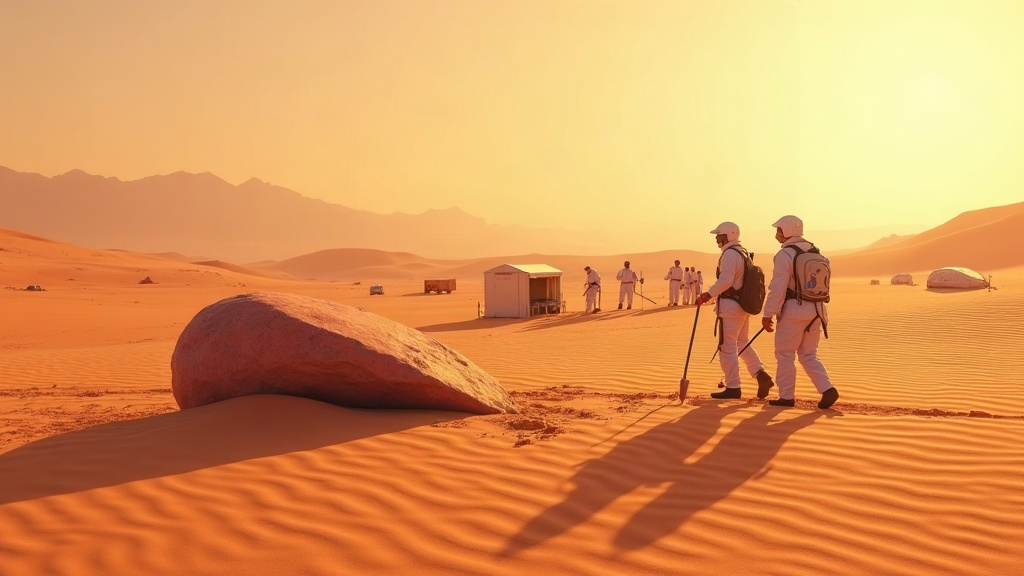
A rose-colored meteorite unearthed in the Sahara Desert has been identified as a 4.1-billion-year-old fragment from Mars, according to NASA scientists. The meteorite, named Teghaza 001 after the salt plain in Mali where it was found, is now recognized as one of the oldest known pieces of the Red Planet to have landed on Earth.
The discovery was first made in 2022 when nomadic prospectors came across the unusual stone in Mali’s desolate salt plains. Weighing nearly two pounds, the rock’s distinctive color and composition quickly drew scientific interest. After detailed analysis, researchers at NASA’s Jet Propulsion Laboratory confirmed its Martian origin by comparing its chemical and mineral makeup to data collected by Martian missions.
Teghaza 001 joins a select group of only about 435 Martian meteorites ever identified on Earth, and stands out as one of the three most ancient. Its age and unique characteristics have made it a focal point for planetary scientists seeking to understand the early history of Mars, particularly the formation of its crust and the presence of water on its surface.
According to a study published in the journal Science, Teghaza 001’s volcanic mineral composition indicates it originated from a mass of magma that cooled and solidified into Mars’ outer crust. Subsequent chemical analysis revealed that the meteorite was further altered by underground water, providing rare physical evidence of water’s role in shaping the Martian surface during its formative years.
Lead author Yang Liu of NASA’s Jet Propulsion Laboratory described the meteorite as a “Rosetta Stone for Mars,” highlighting its significance in decoding the planet’s geological and hydrological past. The meteorite’s discovery and analysis offer a rare glimpse into a period when Mars was geologically active and likely hosted liquid water, a key ingredient for life as we know it.
Unlike the other two oldest known Martian meteorites—Allan Hills 84001 and Northwest Africa 7034—Teghaza 001 provides new insights into the processes that shaped Mars’ early crust. Its mineral signature was cross-referenced with remote sensing data from NASA’s Mars Reconnaissance Orbiter, further confirming its ancient Martian origin.
Martian meteorites are typically ejected from the planet’s surface when it is struck by impactors such as asteroids or comets. The resulting debris can travel millions of kilometers through space before entering Earth’s atmosphere and surviving the fiery descent to the surface. While more than 400 Martian meteorites have been catalogued, only a handful offer direct evidence of Mars’ earliest geological history.
The precise timing of Teghaza 001’s ejection from Mars and its arrival on Earth remains unclear, as current scientific methods cannot pinpoint the exact dates of these events. However, its ancient formation age and the evidence of water-altered minerals make it a valuable addition to the small collection of primordial Martian rocks available for study.
Why it matters
The identification of Teghaza 001 as a 4.1-billion-year-old Martian meteorite provides scientists with a rare, tangible record of Mars’ early crust and its interactions with water. According to NASA and the study’s authors, this meteorite offers crucial clues about the Red Planet’s geological evolution at a time when conditions may have been suitable for life.
With only two other comparably ancient Martian meteorites known—Allan Hills 84001 and Northwest Africa 7034—Teghaza 001 significantly expands the dataset available for reconstructing Mars’ formative years. The chemical and mineral evidence of water-driven alteration in Teghaza 001 supports a growing body of research indicating that Mars was once a wetter, more dynamic world, as also suggested by data from NASA’s Mars Reconnaissance Orbiter and other missions.
This discovery is expected to inform ongoing and future Mars exploration efforts, including sample return missions and the search for ancient biosignatures. As scientists continue to analyze Teghaza 001, its unique properties may help refine our understanding of planetary formation, the history of water in the solar system, and the potential for life beyond Earth.
The image accompanying this article is an AI-generated illustrative depiction inspired by the actual scene of the event.