




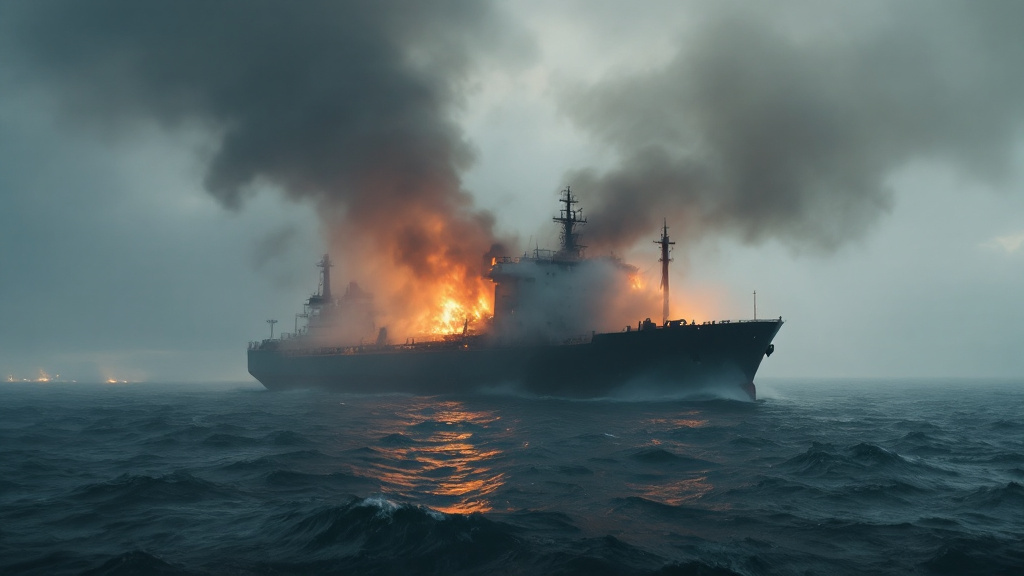
Rescue efforts are under way in the Gulf of Finland after a Russian cargo ship was struck by drones and caught fire in international waters west of Suursaari, according to Finnish and Russian authorities. The attack, detected by the Finnish Defence Forces early Saturday, targeted the vessel Sparta II, which is reported to have links to Russia’s armed forces.
Finnish officials said the incident occurred in international waters, but the damaged ship later drifted into Finnish territorial waters, prompting a coordinated response from Finland’s Border Guard and rescue services. The crew of the Sparta II did not initially abandon ship, but later began evacuation procedures using life rafts and a rescue boat, according to statements cited by Al Jazeera and France 24.
The Finnish Defence Forces confirmed detecting the drone attack on Saturday morning, with the ship subsequently catching fire. Authorities imposed temporary restrictions in the area and alerted NATO as a precaution, reflecting heightened tensions in the Baltic Sea region. No casualties or environmental damage have been reported so far, and Finnish officials are monitoring the situation closely.
While no group has officially claimed responsibility for the strike, Finnish authorities and international media have pointed to the likelihood that the drones were launched by Ukraine. The cargo ship is known to operate along strategic routes connecting mainland Russia with Kaliningrad, a heavily militarized Russian exclave on the Baltic Sea.
The Sparta II was reportedly en route to Kaliningrad when it was attacked. The vessel, which has been linked to Russia’s armed forces by Finnish officials, plays a role in transporting goods along a maritime corridor that is vital for Russian military and commercial logistics. This route is especially sensitive, as it passes through waters adjacent to NATO member states and is a key access point for Russia’s Baltic Fleet.
Finnish Prime Minister Petteri Orpo commented on the incident, describing it as evidence of the war in Ukraine “spilling over into our neighboring regions.” The Finnish government has not attributed blame for the attack but has emphasized the need for vigilance and close cooperation with NATO allies amid growing security concerns in the Baltic region.
The Gulf of Finland is a critical maritime passage connecting Saint Petersburg to the wider Baltic Sea and serves as a major shipping lane for Russian exports and military supplies. The region has seen increased military activity and surveillance since Finland joined NATO, with both Russian and Western forces stepping up patrols and monitoring operations.
This drone strike comes just ten days after Ukrainian drones reportedly targeted a Russian missile corvette in the same area, underscoring a pattern of attacks on Russian naval assets in the Baltic and Black Seas. The latest incident highlights the expanding reach of drone warfare and the growing risks to commercial and military shipping in contested waters.
Why it matters
The attack on the Sparta II marks a significant escalation in the use of drone warfare beyond the immediate conflict zone in Ukraine. According to Finnish authorities, the incident demonstrates the vulnerability of Russian maritime logistics in the Baltic Sea and the potential for the Ukraine war to impact neighboring regions, including NATO territory.
The Gulf of Finland is not only a vital shipping route for Russia but also a strategic flashpoint between Russia and NATO. Finland’s decision to alert NATO and impose temporary maritime restrictions reflects the seriousness of the incident and the broader security implications for the alliance. The Sparta II’s reported links to Russia’s armed forces, as noted by Finnish officials, add to concerns about the militarization of civilian shipping and the risks to regional stability.
Observers are closely watching how Russia, Ukraine, and NATO respond to the latest strike, especially given the proximity to key Russian military installations in Kaliningrad and the recent history of similar attacks. The situation underscores the need for robust maritime security measures and continued international coordination to prevent further escalation in the Baltic Sea.
The image accompanying this article is an AI-generated illustrative depiction inspired by the actual scene of the event.