




Japan has launched a groundbreaking mission to collect rock and dust samples from Phobos, one of Mars’ two moons, aiming to return them to Earth for the first time. The Martian Moons eXploration (MMX) spacecraft, developed by the Japan Aerospace Exploration Agency (JAXA), lifted off before dawn from the Tanegashima Space Center in southern Japan, marking a major milestone for the country’s space program.
The MMX spacecraft was carried into space by an H3 rocket, with the launch taking place at 4:41 a.m. local time, according to JAXA. The rocket’s flight and the spacecraft’s separation proceeded as planned, officials said. The mission, which will span five years, is scheduled to bring back at least 10 grams of material from Phobos by 2031, potentially providing the first-ever samples from a Martian moon.
The mission is a collaboration between JAXA and several international partners, including NASA, the French and European space agencies, and the German Aerospace Center. According to Scientific American and other sources, the MMX spacecraft will spend about a year traveling to Mars before entering orbit around the planet in September 2027. Once in orbit, it will survey Phobos and identify two suitable landing sites for sampling.
A key component of the mission is the deployment of a small rover, named IDEFIX, developed jointly by French and German teams. IDEFIX will scout the surface of Phobos for approximately 100 days, helping mission controllers avoid hazardous terrain and select the safest location for the main lander to touch down and collect samples. The mothership, equipped with a four-legged stationary lander, will then attempt to gather at least 10 grams of rock and dust from the moon’s surface, with the collection phase expected to take place in late 2028 or 2029.
The MMX mission also aims to study Mars’ smaller moon, Deimos, from orbit, although it will not attempt a landing there. In addition to its scientific objectives, the mission will examine whether Phobos could serve as a “natural space station” for future crewed Mars exploration, officials said. Establishing the requirements for a round trip to Phobos is considered essential for advancing human exploration of Mars.
The launch is seen as a significant achievement for Japan’s space program, especially after the H3 rocket experienced a failure during its maiden flight in 2023. The successful deployment of MMX is expected to bolster confidence in Japan’s launch capabilities and its role in international space exploration efforts.
Scientists hope that analyzing samples from Phobos will provide new insights into the origins of Mars’ moons and the processes that shaped the early solar system. The mission’s findings could help resolve longstanding questions about whether Phobos is a captured asteroid or formed from debris after a massive impact on Mars.
The MMX spacecraft is now on its way to Mars, with its arrival scheduled for September 2027. Over the coming months, JAXA and its partners will monitor the spacecraft’s journey and begin preparations for the complex landing and sampling operations ahead.
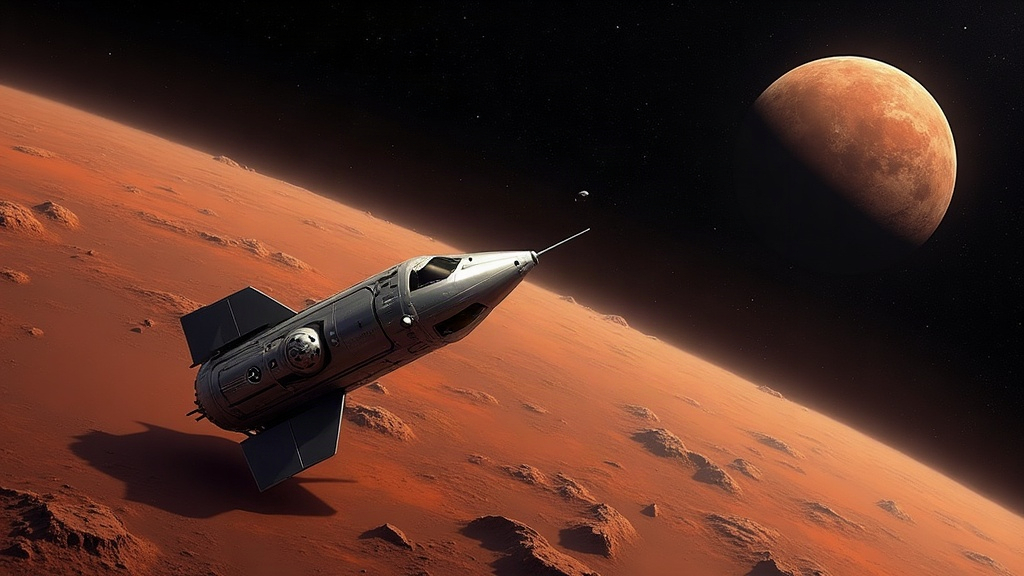
The image accompanying this article is an AI-generated illustrative depiction inspired by the actual scene of the event.