




Scientists have uncovered fossils of a bizarre, armoured amphibian that lived entirely in the sea, according to new research published today. The discovery, made in China’s Guizhou province, identifies Gerrothorax maritimus as the earliest known amphibian adapted to a fully marine lifestyle, challenging long-held assumptions about amphibian evolution.
The findings, reported by Nature and widely shared by paleontologists on social media, describe a creature that lived approximately 237 million years ago. Gerrothorax maritimus possessed bony armor, external gills, and a fishlike physiology, enabling it to survive in saltwater environments without needing to return to freshwater or land.
According to the research, the animal’s unique adaptations included specialized gills capable of filtering out salt from seawater. This feature, combined with its robust body armor, would have allowed the amphibian to thrive in the open sea, a habitat previously thought to be inaccessible to amphibians of the period.
The fossils were recovered from marine sediment layers in Guizhou, providing direct evidence that Gerrothorax maritimus lived and died in a fully marine ecosystem. The discovery fills a crucial gap in the evolutionary record, illustrating how some amphibians developed the ability to inhabit oceanic environments much earlier than previously documented.
Social media posts from Nature and paleontologist Thomas R. Holtz, Jr. highlighted the significance of the find, describing it as an “evolutionary game-changer”. The research has quickly gained attention among scientists and the public, with thousands viewing and sharing the news online.
Until now, amphibians have been considered primarily freshwater or terrestrial animals, with only a few modern species showing limited tolerance to brackish or saline water. The adaptation of Gerrothorax maritimus to fully marine conditions suggests that amphibians experimented with a broader range of habitats during their evolutionary history than previously recognized.
Gerrothorax maritimus is distinguished not only by its armor and gills but also by its overall fishlike biology. The animal likely occupied a niche similar to that of modern marine fish, feeding and breeding entirely in the sea. Its discovery suggests that the evolutionary transition from freshwater to marine environments occurred independently in multiple vertebrate lineages.
The research team emphasizes that these findings challenge established views on the ecological limits of early amphibians. By demonstrating that at least one lineage successfully adapted to marine life, the study opens new avenues for understanding the evolutionary pressures and innovations that shaped vertebrate diversity in ancient seas.
Why it matters
This discovery represents a major shift in our understanding of amphibian evolution, according to Nature and experts cited in the latest reports. The identification of Gerrothorax maritimus as the first fully marine amphibian provides direct evidence that amphibians were able to overcome physiological barriers to saltwater survival much earlier than previously thought.
The research has immediate implications for evolutionary biology, as it demonstrates that the colonization of marine environments was not limited to fish and later reptiles or mammals. Instead, amphibians also played a role in the early diversification of marine vertebrates. The find, highlighted by Thomas R. Holtz, Jr. and others, suggests that the evolutionary history of amphibians is more complex and dynamic than standard models have assumed.
As scientists continue to analyze the fossils and search for related species, the discovery of Gerrothorax maritimus will likely prompt a re-examination of the fossil record for other potential marine amphibians. The case from Guizhou province underscores the importance of ongoing paleontological research in revealing unexpected chapters in the story of life on Earth.
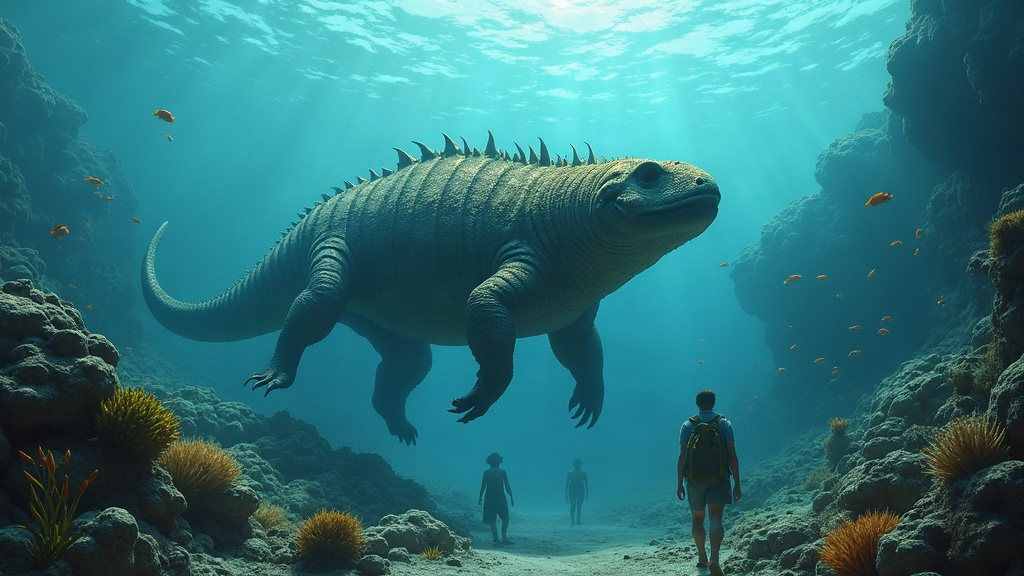
The image accompanying this article is an AI-generated illustrative depiction inspired by the actual scene of the event.