




Russian President Vladimir Putin has agreed to allow European officials to join the next round of talks aimed at ending the war in Ukraine, according to US envoys Steve Witkoff and Jared Kushner. The announcement follows a meeting between the US envoys and Putin in Moscow, marking a significant shift in the diplomatic process that has so far excluded direct European participation.
US officials said the agreement was reached after two days of negotiations in Abu Dhabi involving American, Russian, and Ukrainian representatives. The American delegation is now in Dublin to brief Ukrainian President Volodymyr Zelenskyy on the outcome and discuss next steps, according to statements reported by the Washington Post and AFP.
Europe has long sought a seat at the negotiating table, arguing that any settlement over Ukraine would have profound implications for the continent’s security. Until now, Russia had resisted European involvement, preferring to keep the talks limited to the US, Ukraine, and itself. Putin’s decision to allow European participation is seen as a notable concession, though he reiterated his strong opposition to the deployment of European peacekeepers in Ukraine.
“It is very good that Europeans are now part of these talks,” a US envoy said, while cautioning that Europe is not yet directly involved when Russians are present at the table. The Americans urged Europe to identify a single representative to speak on behalf of the bloc, a request echoed by both Moscow and Washington in recent statements.
Despite the breakthrough on participation, significant obstacles remain. Putin has made clear he will not compromise on Russia’s demands to control parts of Ukrainian territory that Moscow claims to have annexed. He also ruled out agreeing to any foreign peacekeeping troops in Ukraine, describing such a deployment as a “continuation of war,” according to AFP.
The talks come nearly five years after Russia launched its full-scale invasion of Ukraine, resulting in tens of thousands of casualties and the displacement of millions. While Ukraine’s President Zelenskyy has described a “window of opportunity” to achieve progress before 2027, hopes for a swift resolution remain muted. Recent Russian attacks on Ukrainian civilian targets have further complicated the prospects for peace, with US and European officials emphasizing the need for Russia to demonstrate genuine interest in ending the conflict.
The diplomatic push is taking place against a backdrop of shifting alliances and concerns over the current US administration’s commitment to European security. Many European leaders, including French President Emmanuel Macron, have called for a united European approach and a clear vision for the continent’s future security architecture.
In a French-backed declaration in Dublin, 39 countries insisted that “any matter affecting European security should be decided with the Europeans.” The Americans and Russians have both pressed Europe to name a single negotiator, underscoring the complexity of coordinating a unified European position.
Reactions to the development have been mixed. Some European officials welcomed the opportunity to participate, while others expressed skepticism about Russia’s intentions and the likelihood of meaningful progress. Social media commentary highlighted ongoing doubts, with critics questioning whether the talks can achieve tangible results given Russia’s continued military operations and uncompromising stance.
Why it matters
Putin’s agreement to European participation in the Ukraine peace talks marks the first time since the start of the war that Europe will have a formal seat at the table, according to US and European officials. This shift could alter the balance of diplomatic power and ensure that European security concerns are directly represented in negotiations that will shape the region’s future.
The decision comes as both the US and Russia urge Europe to present a unified voice, with calls for a single negotiator to represent the bloc’s interests. French President Emmanuel Macron and 39 other European leaders have emphasized the importance of European involvement, reflecting growing anxiety over the direction of the talks and the continent’s security architecture.
While the inclusion of European representatives is a significant step, the core issues remain unresolved. Putin’s refusal to compromise on territorial demands and his opposition to peacekeeping forces suggest that the path to a comprehensive settlement will be difficult. The next round of talks will test whether the expanded format can overcome entrenched positions and deliver progress toward ending Europe’s most devastating conflict in decades.
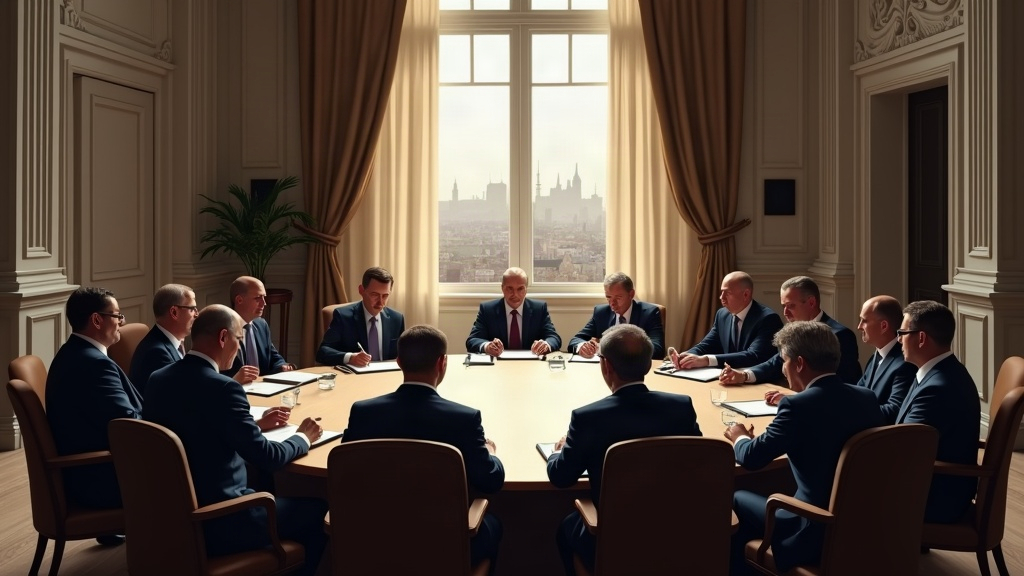
The image accompanying this article is an AI-generated illustrative depiction inspired by the actual scene of the event.