





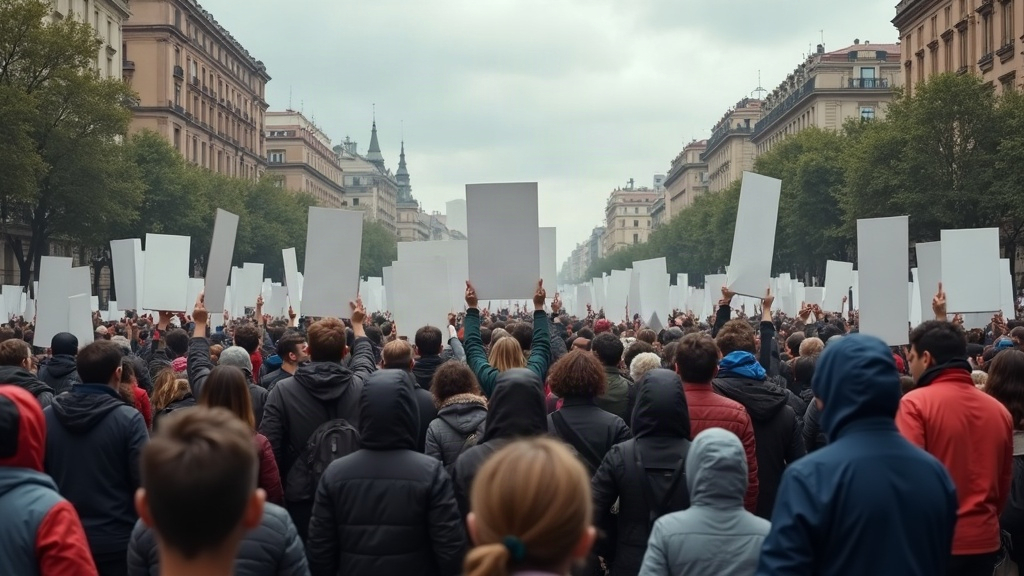
Millions of workers across Spain walked off the job on Wednesday, launching a nationwide general strike that brought transport and businesses to a standstill in protest against the country’s deepening housing affordability crisis. The strike, called by Spain’s two largest unions, UGT and CCOO, is the first of its kind in 14 years and comes less than three weeks before a snap general election.
Demonstrators braved stormy weather to set up picket lines in major cities including Madrid and Barcelona, chanting slogans such as “while you work, they are stealing from you” and “you’re either with the capitalists or the working class,” according to The Straits Times. The protest, which began at midnight, exceeded union expectations for turnout, with millions participating and significant disruption reported nationwide.
Transport was heavily affected, with about 5% of flights cancelled at airports across the country, according to Spain’s airport operator AENA. In Madrid, dozens of protesters attempted to block buses from leaving a municipal depot, while in Andalusia, the regional broadcaster Canal Sur suspended its morning news bulletin in solidarity with the strike.
The strike was organized under the slogan “Salaries. Housing. Prices.”, reflecting widespread anger over rising living costs and stagnant wages. The unions have demanded urgent government action to address the housing shortage, which has pushed rents and home prices out of reach for many Spanish families. According to union leaders, the strike was a “success in terms of turnout,” highlighting the scale of public frustration.
The housing crisis has become a central issue in the run-up to the election. The government has responded by pledging to build more homes and lower taxes on construction and home-buying, measures it says are necessary to counter a 40% increase in the cost of buying a new home over the past decade. However, unions and tenant groups argue that these measures are insufficient given the estimated deficit of 750,000 homes, a shortfall expected to surpass one million by 2028.
Tensions have been building for months, with the crisis brought into sharp focus earlier this year by the eviction and subsequent death of 87-year-old Maricarmen Abascal in Madrid. Abascal, who had lived in her home for over 70 years under a “renta antigua” lease, became a symbol of the struggle faced by vulnerable tenants amid rising evictions and legal battles with landlords.
Reports from Barcelona and other cities described clashes between protesters and police, as well as incidents of vandalism. Despite these tensions, the strike remained largely peaceful, with union leaders emphasizing the need for urgent dialogue and reform.
The day’s events unfolded under severe weather warnings, as storms Charles and Bruna swept across the country. The national weather agency AEMET issued alerts for 14 regions, but the adverse conditions did little to deter demonstrators from joining afternoon marches and rallies.
Government officials, speaking on state broadcaster TVE, acknowledged the scale of the crisis and reiterated their commitment to increasing housing supply and making homeownership more affordable. However, they also warned that deep reforms would take time to implement.
Why it matters
The general strike marks a turning point in Spain’s housing debate, bringing together workers, tenants, and unions in a coordinated show of force just weeks before a pivotal election. The scale of participation, described by CCOO secretary general Unai Sordo as exceeding expectations, signals widespread discontent that could reshape the political landscape.
The government’s response—promising increased homebuilding and tax cuts—reflects mounting pressure to address a crisis that has left hundreds of thousands without affordable housing. The death of Maricarmen Abascal and the estimated shortfall of over 750,000 homes, as reported by union and tenant groups, have made housing a defining issue for voters and policymakers alike.
With the snap election looming, the outcome of these protests and the government’s ability to deliver meaningful reform will be closely watched by unions, tenant organizations, and millions of Spaniards struggling with rising costs. The events of today underscore the urgent need for solutions to Spain’s housing crisis, as well as the growing willingness of civil society to mobilize for change.
The image accompanying this article is an AI-generated illustrative depiction inspired by the actual scene of the event.