




In a groundbreaking endeavour, Japan is set to launch the world’s first mission on October 19, 2026, at 3:41 p.m. ET, aiming to bring back soil samples from Phobos, one of Mars’ moons. Backed by the Japan Aerospace Exploration Agency (JAXA), this ambitious expedition, known as the Martian Moons eXploration (MMX), will be launched from an H3 rocket at the Tanegashima Space Center.
The MMX mission will carry a range of international instruments, including a rover jointly developed by France and Germany, a NASA sampling device, and a European Space Agency (ESA) communication device. This five-year expedition aims to provide crucial data on the formation and origins of Phobos and its sibling Deimos, potentially shedding light on the very beginnings of life in our Solar System.
The spacecraft is estimated to return samples to Earth by 2031. This lunar soil acquisition endeavor is expected to gather at least 10 grams from Phobos, identified to be collected from the moon’s surface layer at a depth of two centimeters or more. Yasuhiro Kawakatsu, the project manager of MMX, highlighted that the obtained samples would serve as pivotal data for assessing the possibility of using Phobos as a base for future crewed expeditions to Mars.
As per ABC News, the spacecraft is carrying 13 instruments, out of which the French-German rover called ‘Idefix’ will be the first to land on Phobos. During its mission spanning about 100 days in 2029, Idefix will explore the moon’s surface, facilitating Japanese soil-sampling endeavors. Once the MMX lands, JAXA scientists plan to carry out two sampling attempts using US and Japanese methods.
The mission encompasses a three-year observation period around Mars, expected to commence about a year post-launch. Highlighting the skilful engineering required for this mission, the exploration module is equipped with four landing legs designed to touch down on Phobos, which has only about one-2,000th of Earth’s gravity.
As nations across the globe, including the United States and China, express their plans to send astronauts to Mars, the MMX mission indeed stands as a milestone in the history of space exploration, paving the way for future expeditions to the Red Planet.
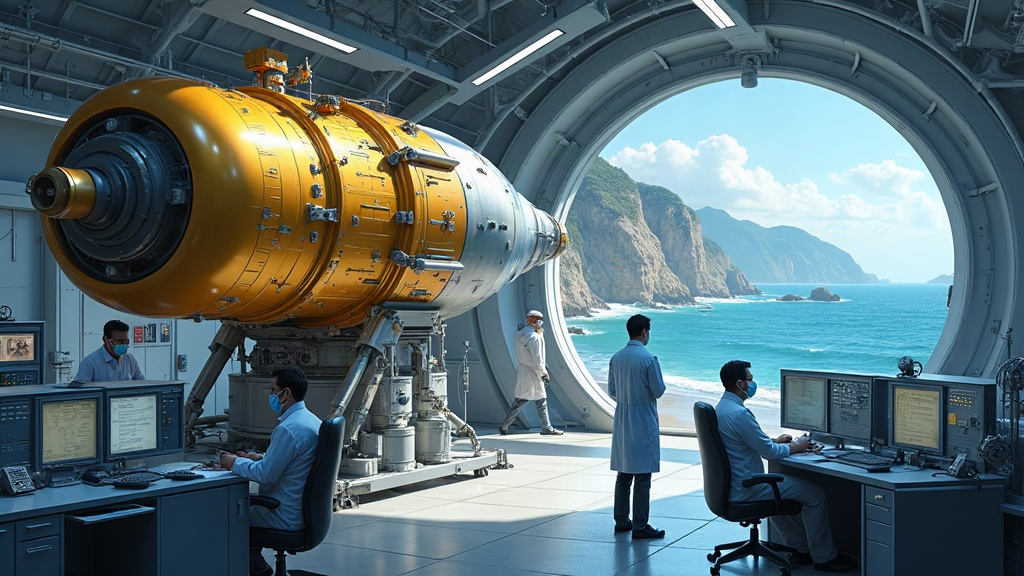
The image accompanying this article is an AI-generated illustrative depiction inspired by the actual scene of the event.